How to see upcoming solar eclipses in 2026 & beyond– Vegas Express Jet is an expert in Personal and Group Travel. We offer Jet charter aircraft with seating for 4-30 Seats. Individual Travelers may prefer our Business/First Class options- this includes American Airlines. One of our preferred partners.
Please credit the expertise By Robert Goldberg. November 25, 2025. This was originally published by AAA California!
The U.S. experienced 2 historic total solar eclipses in 2017 and 2024, but there won’t be another one in the contiguous U.S. until 2045.
Here’s the good news: If you’re willing to travel, you won’t have to wait nearly that long. Each of the next 3 years will see a total eclipse of the sun pass across some of the most desirable travel destinations on Earth:
- August 12, 2026 in Iceland and Spain
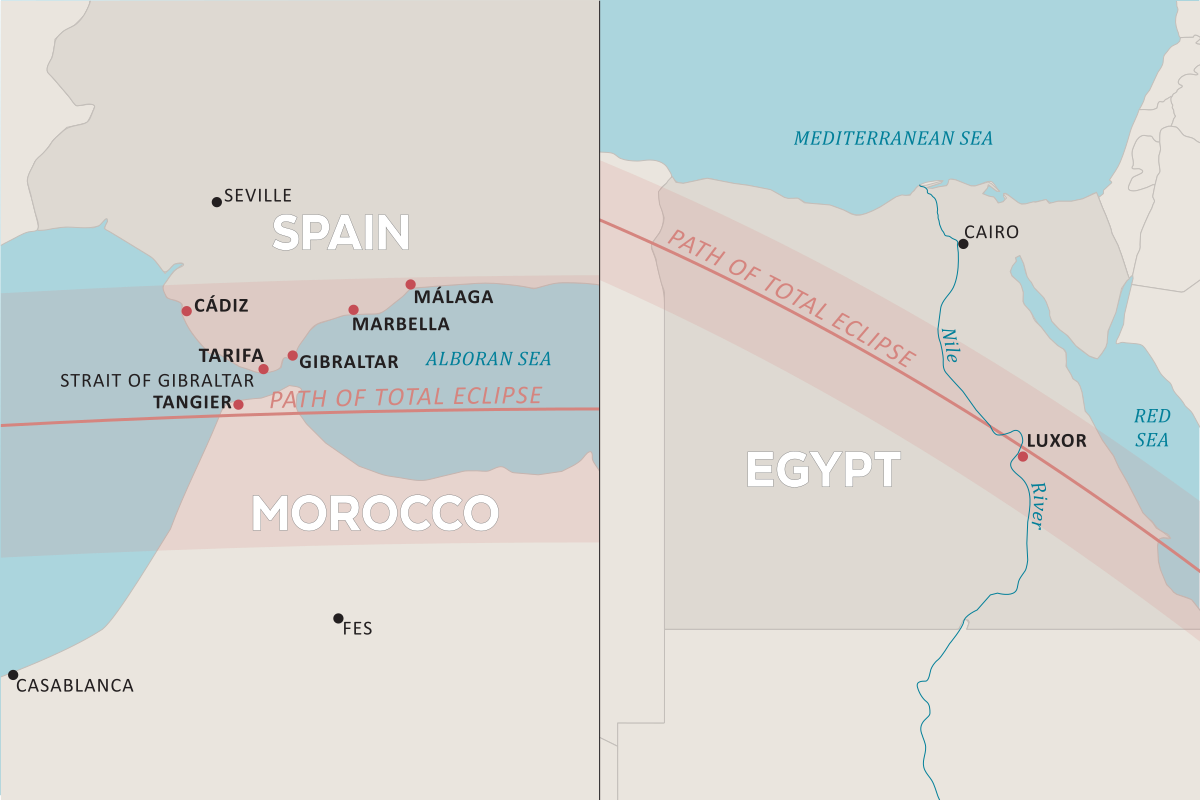
- August 2, 2027 in Spain, Morocco, and Egypt
- July 22, 2028 in Australia and New Zealand
We look at the exact paths these total eclipses will take and where you’ll have the best odds of seeing them, plus other considerations for eclipse travel.
| August 12, 2026 Iceland & Spain |
August 2, 2027 Spain, Morocco, & Egypt |
July 22, 2028 Australia & New Zealand |
|---|
Eclipse basics
Partial vs. total solar eclipses
A partial solar eclipse occurs when the moon blocks some but not all of the sun. Noteworthy partial eclipses typically last a few hours. Annular eclipses are a special type of partial eclipse where the moon appears to be “inside” the sun and is surrounded by a “ring of fire” for a few minutes.
Because partial and annular solar eclipses don’t cover the whole sun, they can only be viewed through very dark-tinted eye protection or indirectly, so while still impressive, they’re not as compelling as a total eclipse.
During a total solar eclipse, the moon entirely blocks the sun, a phenomenon known as “totality.” Though it only lasts a few minutes in any one location, totality is the most spectacular part of the event: You can look at it with the naked eye, stars are visible during the day, and the sun’s corona is visible.
Viewers of a total solar eclipse will also see a partial eclipse in the hours before and after totality as the moon slowly moves across the sun.
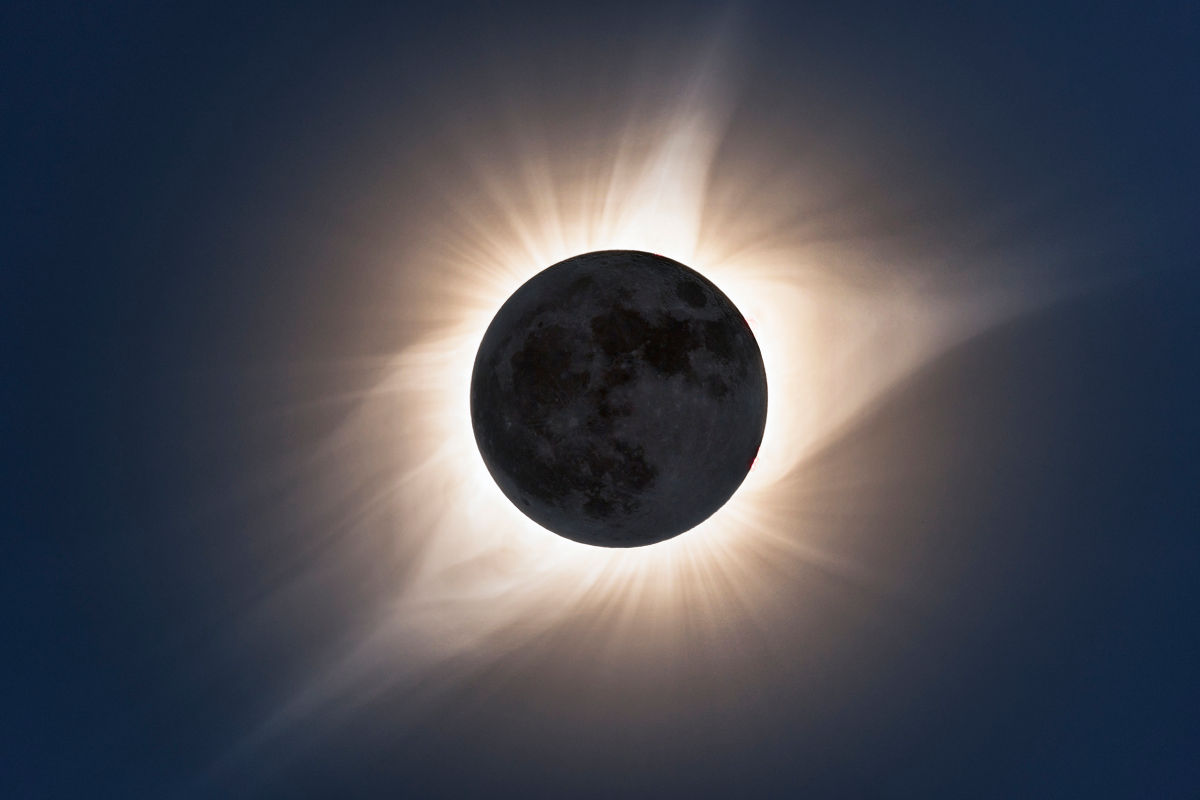
During a total eclipse, the sun’s corona is visible as wispy streaks.
Safe viewing
Proper eye protection is necessary to view a partial solar eclipse; even when almost entirely covered, the sun can still cause serious eye damage. Regular sunglasses aren’t enough—those who plan to look directly at the partial eclipse should buy specialized eclipse viewers that use appropriate solar-filtering material.
Another tried-and-true method is to make a simple pinhole camera by poking a hole in a sheet of paper and letting the sun project through it onto another surface.
Eye protection isn’t necessary during the brief total solar eclipse since the sun is completely obscured. However, viewers should ensure that the total eclipse has truly begun before removing protective eye gear, and be sure to put it back on immediately as soon as the total eclipse transitions back into a partial eclipse.
Picking a viewing location
To see a total solar eclipse, you must be within a narrow band known as the “path of totality”—a curved line that the moon’s shadow will follow across Earth’s surface.
There are a few key considerations when deciding where to go to view an eclipse within the path of totality:
- Cloud cover and rainy weather will block your view of the sun. If cloud cover is reliably predicted for your viewing spot, look for another spot with better odds of clear skies.
- All else equal, lower elevations are better than higher ones, as they are less likely to develop cloud cover.
- Because the moon’s shadow is a circle, viewing spots closer to the centerline of the eclipse path will see longer total eclipses. For example, in the 2026 eclipse, Bilbao in Spain will be at the edge of the path and only see about 30 seconds of total eclipse, while about 150 miles to the west, Oviedo near the centerline will see about 1 minute and 48 seconds of total eclipse.
- Public gathering places such as parks and observatories will be crowded the day of the eclipse. Arrive early or seek an out-of-the-way venue instead. Expect traffic after the eclipse, too, as many viewers try to leave at once.
August 12, 2026 in Iceland & Spain
Maximum eclipse duration: 2 minutes, 18 seconds
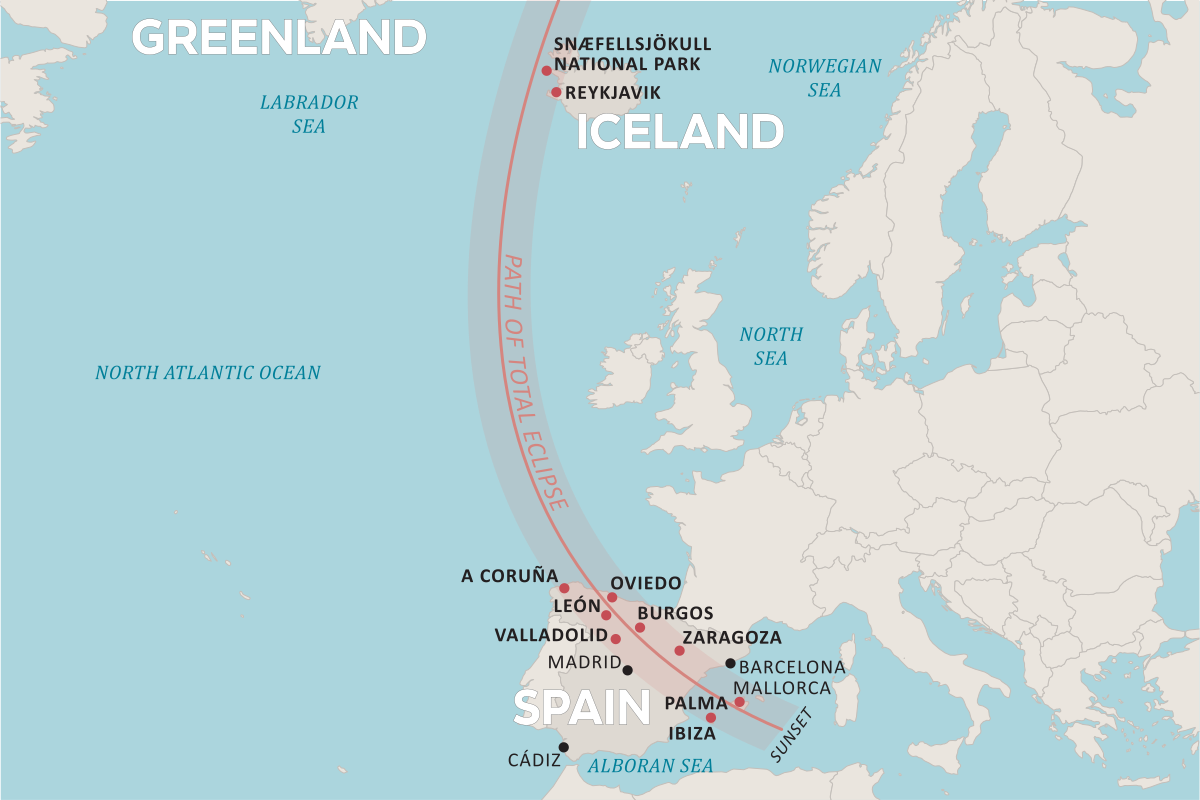
Eclipse predictions by Fred Espenak, NASA/GSFC emeritus
Viewing options: Iceland
The first eclipse on our list will begin in Greenland before cutting south to graze Iceland’s Westfjords region and then sweeping east across northern and eastern Spain. The path includes the Icelandic capital and travel hotspot Reykjavík, though its location near the path’s edge means the total eclipse will last about 57 seconds here.
The biggest concern is clouds: Icelandic weather is highly variable and cloudy skies are more common than not in August. If you’re willing to take your chances on land, your best bet is to watch the forecasts in the days leading up to the eclipse and be ready to relocate to wherever clear skies are most likely. Keep in mind that smaller roads outside Reykjavík may be closed to avoid being overwhelmed by visitors.
Alternatively, book an eclipse cruise off the Iceland coast—a cruise ship can reposition to where the forecast is most promising, and there’s no headaches navigating traffic, parking, and hotel bookings.
Looking for a hotel in Iceland?
Save up to 10% as a AAA member when booking AAA room rates with our preferred partner hotels in and near the eclipse path.
Transatlantic Crossing, Norway and Iceland
Immerse yourself in Iceland and Norway on this 14-night voyage, timed to coincide with the solar eclipse.
Solar Eclipse with Greenland and Scotland
Enjoy a front-row seat to the 2026 solar eclipse while on a cruise at sea off the coast of Iceland.
Viewing options: Spain
The August 2026 total eclipse will pass through 3 different regions of Spain, each with their own advantages and drawbacks: the Cantabrian Coast in the north, the Meseta Central in the middle, and the Mediterranean coast and Balearic Islands in the east.
An unusual consideration in Spain is that the total eclipse will take place close to sunset, low in the sky. The farther east you go, the lower the eclipse will be, and the more you’ll need to both find an unobstructed view of the western horizon and also count on not having any distant clouds blocking your view.
Cantabrian Coast: Thanks to moist Atlantic air, this region is often cloudy in August. The most notable city for viewing is Oviedo, with a 1 minute, 48 second total eclipse. A Coruña to the west will see 1 minute, 15 seconds of totality, and if you’re tolerant of the risk, you could plan to reposition along the coast as the forecast dictates. The total eclipse will be 10 degrees above the horizon—about the height of a fist with thumb extended if you put it out at arm’s length—so plan accordingly.
Meseta Central: Spain’s drier interior plateau has much better odds of being clear on the big day, though the sun will be a little lower in the sky (about 7-8 degrees). The farther from the sea, the fewer the clouds, which would point to Valladolid (1 minute, 28 seconds) and Zaragoza (1 minute, 23 seconds) as the best choices for major cities.
Mediterranean coast: The Mediterranean’s warm waters are the place you’re least likely to find clouds in August, making the Balearic Islands of Mallorca and Ibiza the best choice from a weather perspective. However, the sun will be very low in the sky by this point—just 2 degrees above the horizon—so you’ll need a completely unobstructed view of the horizon. That means you’ll either want to be on the northwest shore of the islands, or aboard a cruise ship.
Looking for a hotel in Spain?
Vegas Express Jet will take car of your entire journey. From a Private Jet to Business Travel with a custom crafted itinerary and your hotel accommodations.
Mediterranean Solar Eclipse
Enjoy an overnight in Barcelona, scenic ports in Spain and Italy, and a front-row view of the eclipse from the ship’s roomy deck.
Mediterranean with Total Solar Eclipse
See Barcelona, Cartagena, and Gibraltar, catch the eclipse at sea, and follow it up with Tuscany and Rome.
August 2, 2027, in Spain, Morocco, & Egypt
Maximum eclipse duration: 6 minutes, 23 seconds
You’re invited to explore the options- from your own Private Jet Charter with seating for up to 30 travelers to Business Class air, recommended for smaller parties and individual travelers. Combine you stay with a customized itinerary with an extended stay in Europe. Group travelers will be able to enjoy a complete 10-14 tour in Spain or Iceland. We will be here to follow your wishes. Other options include a one way private jet charter allowing travelers to plan their very own extensions in Iceland or Spain. You can expect the following from our Team Members.
- Charter rates for Private Jets are always available- feel free to share the costs if you are a group organizer.
- Optionally we will be here to provide you with special rates for Business Class Air with major US Airlines (American Airlines).
- Our Team Members will be delighted to provide you with a custom crafted itinerary and include a special stay at the viewing locations. We suggest that you limit the tour to 7-10 days and provide your guests with options to extend their European Visit with extended stays in Europe,
- What we don’t offer includes pricey Jet cards or member ship fees. Our Travel Team is fully IATA accredited. All the charter aircraft we will offer are ARG/US Gold or Platinum rated.
- Your security is paramount–to this end we will never ask you for personal or credit card information. You have the option to pay in a secure payment process after you accept a written charter agreement of flight confirmation. You always pay the operator direct.
- We strongly recommend that you purchase travel insurance to provide you with medical coverage, baggage and trip insurance. You will be able to compare rates and options before you depart. Our Travel Advisors will provide you with a wide range of options. The choice is yours.